
How Your Thoughts Shape Your Feelings: Understanding Cognitive Distortions
Have you ever noticed how your mood can change instantly because of a single thought? One moment you’re okay, and the next you feel anxious, sad, guilty, or overwhelmed—without anything dramatic happening externally.
According to psychiatrist Dr. David Burns, author of Feeling Good, this happens because of something called cognitive distortions.
The good news? Once you learn to recognize them, you can change how you feel—sometimes dramatically.
What Are Cognitive Distortions?
Cognitive distortions are habitual ways of thinking that are inaccurate, exaggerated, or overly negative.
They don’t reflect reality as it truly is, but when we believe them, they strongly affect our emotions.
Dr. Burns explains that many depressed and anxious states are caused not by situations themselves, but by distorted thoughts about those situations.
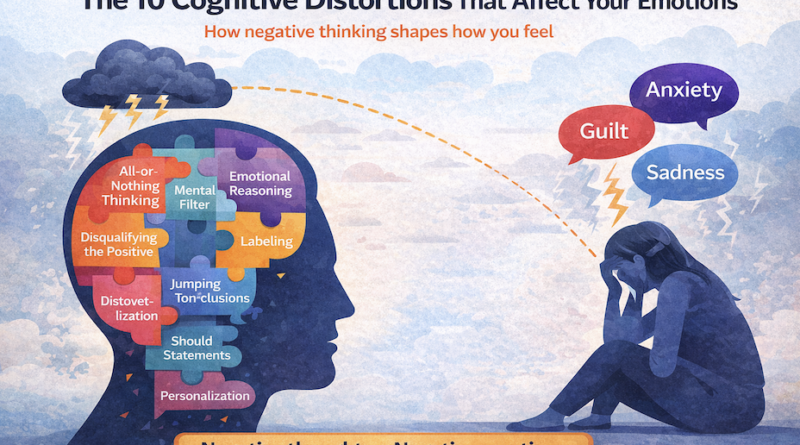
The 10 Common Cognitive Distortions
Here’s a simple overview of the ten distortions described in the book:
1. All-or-Nothing Thinking
Seeing things in black-and-white terms.
“If I’m not perfect, I’m a total failure.”
2. Overgeneralization
Turning one negative event into a never-ending pattern.
“This always happens to me.”
3. Mental Filter
Focusing on one negative detail and ignoring everything else.
“One mistake ruins everything.”
4. Disqualifying the Positive
Rejecting positive experiences by saying they “don’t count.”
“Anyone could have done that.”
5. Jumping to Conclusions
Making negative assumptions without real evidence.
- Mind Reading: “They must think I’m stupid.”
- Fortune Telling: “This will definitely go wrong.”
6. Magnification or Minimization
Blowing problems out of proportion—or shrinking your strengths.
“This mistake is a disaster.”
7. Emotional Reasoning
Believing something is true just because it feels true.
“I feel scared, so something bad must happen.”
8. “Should” Statements
Using rigid rules to judge yourself or others.
“I should always be strong.”
9. Labeling and Mislabelling
Attaching harsh labels instead of describing behavior.
“I’m a loser.”
10. Personalization
Taking responsibility for things outside your control.
“It’s my fault they’re upset.”
What Does the Book Ask You to Do?
Dr. Burns doesn’t just explain these distortions—he gives you a practical method to work with them.
Step 1: Learn to Recognize Them
You are encouraged to study these distortions until you can easily identify them in daily life.
The goal is not to eliminate thoughts immediately, but to notice them.
Step 2: Observe Your Own Thoughts
Whenever you feel emotionally upset, ask yourself:
“What am I telling myself right now?”
Then ask:
“Which cognitive distortion is this?”
Even identifying one distortion is considered a win.
Step 3: Practice With Examples
The book includes short stories (vignettes) and asks you to:
- Imagine you are the person in the story
- Identify the distortions in their thinking
- Avoid checking answers too soon
This trains your mind to catch distorted thinking in real situations.
Step 4: Repeat and Build Awareness
With repetition, something powerful happens:
- Thoughts stop feeling like facts
- You gain distance from negative thinking
- Emotional intensity begins to soften
This skill, according to the book, can benefit you for life.
Why This Works
When you label a thought as a distortion, you create a pause.
That pause gives you choice.
Instead of being controlled by your thoughts, you start observing them—and observation is the first step toward change.
A Simple Daily Practice (5 Minutes)
- Notice a strong negative emotion
- Write down the thought behind it
- Identify the distortion
- Stop there—no fixing, no judging
Awareness alone is powerful.
Final Thought
You don’t need to think positively all the time.
You don’t need to force happiness.
You only need to learn how your mind sometimes lies to you—and gently call it out.
That’s where real emotional freedom begins 🌱