
How Self-Recording Can Improve Your Communication and Confidence
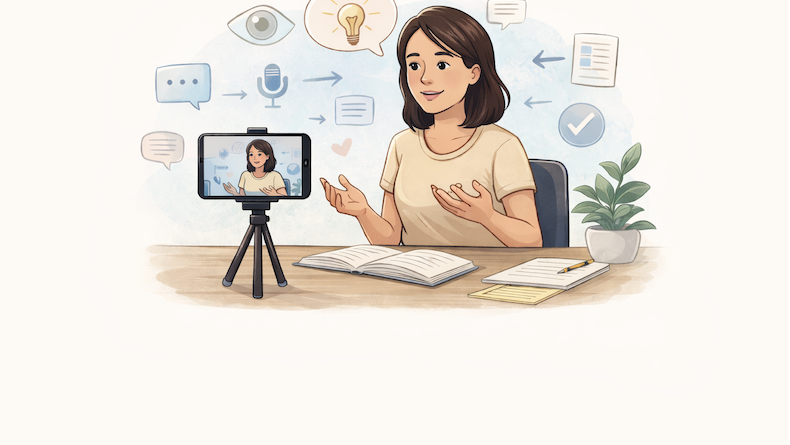
Improving communication skills does not always require public speaking classes or external feedback. In fact, one of the most effective methods is self-observation. By recording yourself, reviewing your voice and body language, and reflecting on the transcript, you can clearly identify patterns that affect how your message is received.
This simple practice helps you become more aware, confident, and intentional in the way you communicate.
Why Self-Recording Is a Powerful Tool for Self-Improvement
Many people speak every day without ever truly listening to themselves. However, when you record yourself and watch it back, you begin to notice details that usually go unnoticed.
For example, you may observe:
- Where your eyes move when you think
- How your hands gesture naturally
- Whether your facial expressions match your emotions
- If your posture appears confident or apologetic
As a result, self-recording creates awareness — and awareness is the first step toward improvement.
Step 1: Record a Short Video With Intention
Start by recording a 3–5 minute video on a simple topic. You can speak about:
- Your day
- A thought on a prompt
- A topic you want to explain clearly
The goal is not perfection. Instead, the goal is honest expression.
Keep the camera steady and speak naturally, just as you would in a real conversation.
Step 2: Review Your Voice and Vocal Delivery
Next, listen to your voice carefully — without judgment.
Ask yourself:
- How does my voice sound when I listen back?
- Does my tone match the message I want to convey?
- When do I sound confident, and when do I sound disconnected?
- What happens to my pitch at the end of sentences?
- Do I pause intentionally, or do I rush through silence?
Over time, this review helps improve clarity, pacing, and emotional connection.
Step 3: Observe Your Body Language and Facial Expression
After that, watch the video again — this time without sound.
Focus on:
- Where you look when thinking
- Your default hand gestures
- Whether your face expresses emotion clearly
- Any repeated visual habits that may distract
- Whether your posture feels confident or closed
This silent review often reveals more than expected and plays a major role in improving communication skills.
Step 4: Transcribe Your Speech Into Text
Once you’ve reviewed the video, convert your speech into text. You can do this manually or with a transcription tool.
This step creates distance from your voice and allows you to evaluate your words objectively.
Step 5: Review the Transcript for Clarity
Now, read the transcript carefully and reflect.
Ask:
- Does each paragraph express one clear idea?
- Are my words simple and easy to follow?
- Do I rely on filler words or repeated phrases?
- Are some sentences unnecessarily long?
- Can someone else read this and understand it easily?
This step strengthens both spoken and written communication.
Step 6: Reflect on Structure and Flow
Strong communication is not only about words, but also about structure.
Consider:
- Is the message logically organized?
- Does one idea flow naturally into the next?
- Does the listener know what I’m trying to say?
Clarity builds trust, and structure builds confidence.
Step 7: Track Improvement Over Time
Finally, write down one communication behavior to improve each week.
For example:
- Week 1: Slowing down speech
- Week 2: Reducing filler words
- Week 3: Improving eye contact
- Week 4: Clear sentence endings
Tracking progress keeps the practice intentional and measurable.
Why This Practice Works
This method works because it combines:
- Self-awareness
- Honest feedback
- Reflection without judgment
- Small, consistent improvement
Rather than trying to change everything at once, you improve one layer at a time.
Final Thoughts
Improving communication skills does not require external validation. When you take the time to observe yourself — your voice, words, and presence — growth happens naturally.
By recording, reviewing, transcribing, and reflecting, you turn everyday communication into a powerful tool for self-development.
Progress begins the moment you choose to listen to yourself.