
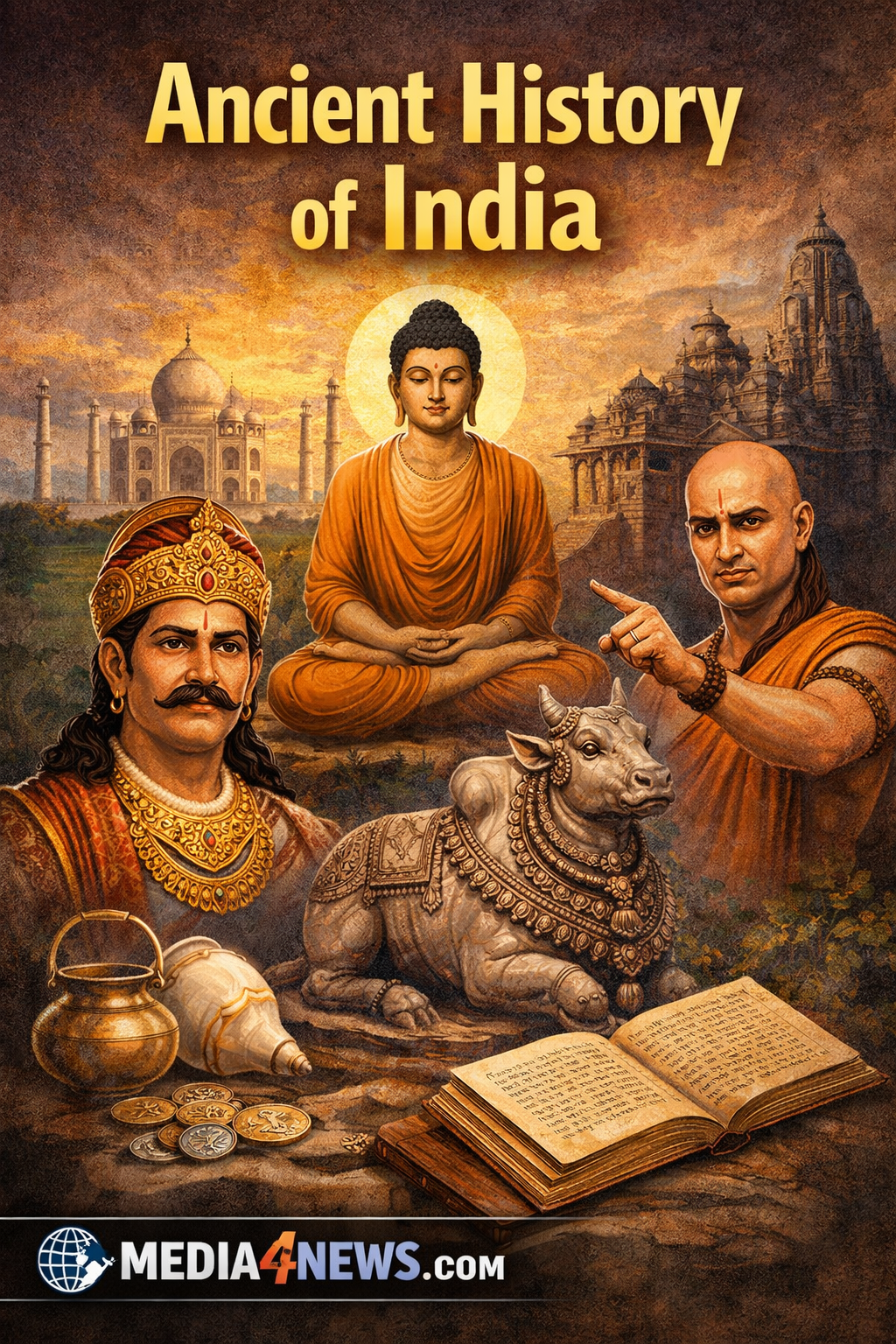
Ancient History of India: Timeline, Civilizations, and Key Facts
The ancient history of India is one of the richest and most fascinating in the world. It spans thousands of years and includes the rise of early civilizations, powerful kingdoms, and significant cultural developments that shaped modern India.
Understanding ancient history helps us learn about the origins of Indian culture, traditions, and society.
What Is Ancient History?
Ancient history refers to the period of human history from the earliest recorded times up to the early medieval period. In India, ancient history generally covers the time from the Indus Valley Civilization (around 2500 BCE) to the end of the Gupta Empire (around 550 CE).
This period includes major developments in art, science, religion, and governance.
Indus Valley Civilization (2500 BCE – 1900 BCE)
The Indus Valley Civilization is one of the earliest known urban civilizations in the world.
Key Features:
- Well-planned cities like Harappa and Mohenjo-daro
- Advanced drainage and sanitation systems
- Trade with other civilizations
- Use of seals and undeciphered script
This civilization shows how advanced urban planning existed in ancient India.
Vedic Period (1500 BCE – 600 BCE)
After the decline of the Indus Valley Civilization, the Vedic Period began with the arrival of the Indo-Aryans.
Key Highlights:
- Composition of the Vedas, the oldest sacred texts
- Development of social structures like the varna system
- Growth of agriculture and settlements
The Vedic period laid the foundation for Indian philosophy and religion.
Mahajanapadas and Rise of Kingdoms (600 BCE – 300 BCE)
During this period, India saw the emergence of 16 major kingdoms, known as Mahajanapadas.
Important Developments:
- Rise of powerful kingdoms like Magadha
- Spread of new religions like Buddhism and Jainism
- Growth of trade and urban centers
This period marked a transition from tribal societies to organized states.
Maurya Empire (322 BCE – 185 BCE)
The Maurya Empire was one of the largest empires in ancient India.
Key Rulers:
- Chandragupta Maurya – Founder of the empire
- Ashoka the Great – Promoted Buddhism and non-violence
Achievements:
- Strong central administration
- Spread of Buddhism across Asia
- Development of roads and infrastructure
The Mauryan period is considered a golden phase of political unity.
Gupta Empire (320 CE – 550 CE)
The Gupta Empire is often called the Golden Age of India.
Key Contributions:
- Advancements in science and mathematics (zero, decimal system)
- Growth of literature and arts
- Development of classical Sanskrit
Prominent scholars like Aryabhata and Kalidasa contributed during this period.
Religion and Culture in Ancient India
Ancient India was a center for the development of major religions:
- Hinduism
- Buddhism
- Jainism
Temples, scriptures, and philosophical teachings from this period continue to influence modern life.
Contributions of Ancient India
The ancient history of India has contributed significantly to the world in various fields:
- Mathematics (concept of zero)
- Astronomy
- Medicine (Ayurveda)
- Philosophy and spirituality
- Architecture and art
These contributions have had a lasting global impact.
Importance of Studying Ancient History
Learning about ancient history helps us:
- Understand cultural roots
- Learn from past civilizations
- Appreciate historical achievements
- Build awareness of heritage
It also helps students and researchers gain insights into human development.
Conclusion
The ancient history of India is a vast and valuable part of the country’s heritage. From the Indus Valley Civilization to the Gupta Empire, this period witnessed remarkable achievements in governance, science, and culture.
Exploring ancient history not only helps us understand the past but also inspires future generations to build on this rich legacy.