
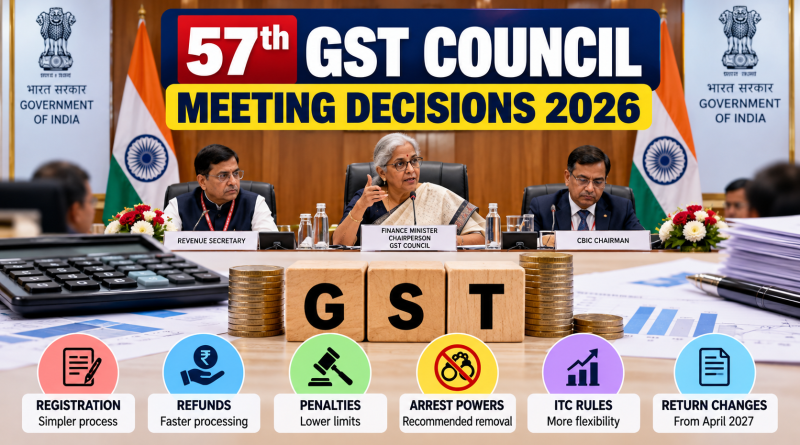
57th GST Council Meeting Decisions 2026: New Rules, Penalties, Refunds and Tax Changes
The 57th GST Council meeting decisions could bring important changes for businesses, taxpayers and online sellers across India.
The GST Council held its 57th meeting on October 8, 2026, in New Delhi. Union Finance Minister Nirmala Sitharaman chaired the meeting.
This time, the Council focused mainly on making GST rules easier to follow. It recommended changes to registration, tax returns, refunds, penalties and legal proceedings.
One major proposal would remove arrest powers under GST. In addition, the Council recommended raising the prosecution threshold from ₹1 crore to ₹5 crore.
The meeting also covered faster refunds, simpler rules for small businesses and tax changes for selected goods and services.
Here is a complete guide to the key recommendations and what they could mean for taxpayers.
57th GST Council Meeting 2026: Key Highlights
The Council announced several proposals to make the GST system simpler and reduce delays.
| Details | Information |
|---|---|
| Meeting | 57th GST Council meeting |
| Date | October 8, 2026 |
| Location | New Delhi |
| Chairperson | Finance Minister Nirmala Sitharaman |
| Main focus | GST process reforms |
| Arrest powers | Recommended removal |
| Prosecution threshold | Proposed increase to ₹5 crore |
| Maximum general penalty | Proposed reduction to ₹10,000 |
| Refunds | Faster processing and more automation |
| Small businesses | Simpler registration and compliance proposals |
Important: These are GST Council recommendations. Some changes need amendments, notifications or new portal features before they take effect.
1. GST Council Recommends Removing Arrest Powers
One of the biggest recommendations concerns arrest powers under GST.
The Council proposed removing Section 69 of the Central Goods and Services Tax Act, 2017.
This section currently provides powers relating to arrest under specified circumstances.
If lawmakers implement the proposal, GST authorities would no longer have arrest powers under that provision.
However, the proposal does not remove every penalty or legal consequence for GST offences.
Businesses must still follow tax laws and meet their payment and reporting duties.
2. GST Prosecution Threshold May Rise to ₹5 Crore
The Council also recommended raising the monetary threshold for prosecution.
The proposed change would increase the threshold from ₹1 crore to ₹5 crore.
This could reduce criminal proceedings for certain lower-value GST cases.
However, the change would not mean that tax amounts below ₹5 crore become exempt from GST.
Authorities could still recover unpaid taxes and apply other legal measures where the law permits.
Therefore, businesses should continue filing correct returns and paying taxes on time.
3. Maximum General GST Penalty May Fall to ₹10,000
The GST Council recommended reducing the maximum general penalty under Section 125.
The proposed change is:
| Penalty | Existing amount | Proposed amount |
|---|---|---|
| Maximum general penalty under Section 125 | ₹25,000 | ₹10,000 |
This proposal applies to the general penalty provision.
It does not mean every GST penalty will fall to ₹10,000.
Different offences have different penalty rules. Therefore, taxpayers should check the relevant legal provision.
4. Small GST Notices Below ₹10,000 May Be Avoided
The Council proposed a minimum tax amount of ₹10,000 for issuing certain show-cause notices.
A show-cause notice asks a taxpayer to explain why the department should not take a proposed action.
Under the recommendation, authorities would not issue the covered notices when the tax amount involved is below ₹10,000.
The proposal also addresses certain pending cases.
This measure could help reduce small tax disputes and save time for both businesses and tax officers.
However, taxpayers should not treat it as a general exemption from paying small GST dues.
5. GST Registration May Become Easier
The Council recommended several changes to GST registration.
For example, it proposed clearer instructions about the documents applicants must submit.
The GST portal may also provide better menus, guidance and application forms.
In addition, the Council recommended changes to Form GST REG-01.
These changes aim to reduce mistakes and unnecessary questions during registration.
As a result, applicants may face fewer delays when applying for a GST number.
6. Faster GST Registration Updates
Businesses often need to change their registered details.
For example, a company may update its address, contact information or business details.
The Council recommended automatic approval for many registration changes.
However, some changes would follow different rules.
Under the proposal, changes to the principal place of business would generally remain outside automatic approval, except for specified taxpayers using the automatic registration route.
This could make routine updates faster.
7. GST Registration Cancellation May Become Simpler
The Council also proposed changes to registration cancellation.
Under the planned system, eligible taxpayers could receive automatic cancellation after meeting the required conditions.
For example, they may need to file pending returns and clear outstanding dues.
The Council recommended a phased approach.
In addition, it proposed a more automated process for certain cancellations and restoration of registration after taxpayers correct their defaults.
These changes could reduce delays for businesses that want to close their GST registration.
8. Faster GST Refunds for Businesses
Refund delays can affect business cash flow.
Therefore, the Council recommended a more automated refund system.
Under the first phase, the GST system could automatically approve eligible refunds of excess balances in electronic cash ledgers.
For certain export-related and inverted-duty refunds, the system could also release 90% of eligible claims provisionally after risk checks.
The Council also recommended reducing the time for issuing refund acknowledgements or deficiency notices from 15 days to 10 days.
These measures aim to reduce waiting time and improve cash flow.
However, actual refund eligibility will still depend on the applicable rules.
9. Input Tax Credit Rules May Become More Flexible
Input Tax Credit, or ITC, allows eligible businesses to claim credit for GST paid on purchases used for business activities.
The Council recommended expanding ITC benefits in certain cases.
For example, it proposed removing some restrictions on credit related to outdoor catering, health and life insurance, telecom towers and certain other business expenses.
In addition, the Council recommended broader refund eligibility for accumulated ITC on selected inputs, services and capital goods.
However, these proposals do not mean every business expense will automatically qualify for ITC.
Businesses must check the final law, conditions and effective dates.
10. New GST Return Changes Proposed for April 2027
The Council recommended changes to make GST returns more accurate.
The proposals focus on reducing differences between sales details, tax liabilities and input tax credit claims.
For example, the GST system could offer better ways to correct certain return details.
It may also improve the matching of information between GSTR-1, GSTR-3B and GSTR-2B.
The Council recommended bringing the revised mechanism into force from the April 2027 return period, subject to the required changes.
Therefore, businesses should watch for official updates before changing their filing process.
11. Easier GST Registration for Small Online Sellers
Small businesses often sell products through online marketplaces.
However, selling across states can create extra registration requirements.
The Council recommended a simpler registration process for certain small sellers using e-commerce platforms.
Under the proposal, eligible sellers could use an e-commerce operator’s warehouse as their principal place of business in a state where they have no physical presence.
The proposal also includes an ITC limit and other conditions.
This could make it easier for small sellers to reach customers in more states.
12. New Optional GST Scheme for Small Businesses
The Council gave in-principle approval to a proposed Annual Return Quarterly Payment scheme.
This optional scheme would target certain businesses with annual turnover up to ₹5 crore.
However, the proposal is limited to eligible businesses that sell only to unregistered customers.
The idea is to reduce the burden of frequent return filing.
Since the Council approved the concept in principle, businesses should wait for the final rules before assuming they qualify.
13. New Rules Proposed for GST Vehicle Checks
The Council recommended changes to the way authorities inspect goods vehicles.
Under the proposal, officers could stop vehicles based on specific information rather than random checks.
In addition, an officer of at least Joint Commissioner rank would need to authorise the interception.
The Council also proposed limits on inspections in states through which goods are only passing.
However, exceptions would apply in cases involving missing e-way bills or missing transport documents.
These changes could reduce delays in goods movement.
14. GST Changes for Selected Goods
The Council also recommended clarifications for several product categories.
These include toys, certain farm products, second-hand vehicles and waste materials.
Toys
The Council clarified the coverage of toys under the relevant GST rate schedules.
This includes categories such as dolls and puzzles, rather than only selected wheeled toys.
Isabgol Seeds
The Council recommended a nil GST rate for psyllium seeds, also known as isabgol seeds, regardless of whether they are fresh, chilled, frozen or dried.
Second-Hand Vehicles
The Council clarified that eligible sellers using the GST margin scheme can claim ITC on certain business expenses.
These may include repairs, spare parts, rent and marketing services.
However, the restriction on ITC for the purchase of the second-hand vehicle itself would continue.
Waste and Scrap
The Council recommended changes to the GST treatment of certain waste materials.
These include plastic scrap, electronic waste, tyre scrap and used cooking oil.
The proposals include reverse-charge rules for specified transactions and 2% tax deduction at source for certain registered business-to-business supplies.
15. GST Changes for Electric Vehicle Services
The Council recommended a 5% GST option for certain passenger transport and vehicle rental services using electric vehicles.
However, the option would come with restrictions on input tax credit.
The proposal also covers specific conditions related to battery charging costs.
Therefore, it should not be confused with a general change in GST on the purchase of electric vehicles.
16. GST Changes for Delivery Services
The Council recommended a 5% GST rate without ITC for specified delivery services connected with e-commerce platforms.
It also proposed changes to how GST applies to certain delivery services supplied through e-commerce operators.
These recommendations could affect online delivery businesses and platforms.
However, the final treatment will depend on the notified rules and the type of service.
17. GST Exemptions for Selected Services
The Council recommended GST exemptions for some services.
These include:
- Certain helicopter passenger services in northeastern states, Sikkim and Bagdogra.
- Storage or warehousing of seeds meant for sowing.
- Coffee-curing services supplied to cultivators.
- Certain services of the Seamen’s Provident Fund Organisation.
The exemptions apply to specific services and conditions.
Therefore, they should not be treated as broad exemptions for every business in these sectors.
18. Relief for Small Taxpayers on Late Fees
The Council recommended late-fee relief for certain small taxpayers.
The proposal covers eligible taxpayers with annual turnover up to ₹5 crore in the previous financial year.
Under the recommendation, the late fee for a delayed return covered by Section 39(1) would be waived if the taxpayer files it by the end of the month in which it was due.
However, this is not a general waiver for all late GST returns.
The final rules will determine how the relief applies.
19. Changes to GST Notices and Appeals
The Council also recommended clearer standards for tax notices and legal proceedings.
These measures aim to improve the quality of notices and reduce avoidable disputes.
For example, tax officers would receive guidance on issuing demand notices, handling hearings and preparing orders.
The Council also recommended changes to penalty rules for certain non-fraud cases.
In addition, it proposed a ₹40 crore upper limit on specified appeal pre-deposits in cases involving only penalties and no tax demand.
These proposals aim to make the dispute process more predictable.
57th vs 56th GST Council Meeting: What Changed?
The 56th and 57th meetings focused on different areas.
| 56th GST Council Meeting | 57th GST Council Meeting |
|---|---|
| Held in September 2025 | Held on October 8, 2026 |
| Focused mainly on GST rate changes | Focused mainly on process reforms |
| Recommended major rate reductions and changes | Recommended simpler registration and refunds |
| Changed the tax treatment of many goods and services | Proposed changes to penalties and prosecution |
| Introduced wider GST rate reforms | Proposed easier compliance and fewer disputes |
Therefore, the 57th meeting should not be described as a complete replacement of the GST rate structure.
Instead, it mainly builds on earlier reforms.
When Will the 57th GST Council Decisions Take Effect?
Not every recommendation has the same start date.
Some changes need amendments to the GST law. Others require new rules, notifications or updates to the GST portal.
For example, the Council recommended introducing certain return changes from the April 2027 return period.
It also proposed specific dates for parts of the expanded ITC refund framework.
However, a recommendation alone does not always make a new rule legally effective.
Therefore, businesses should check the latest official notifications before applying the changes.
How Will the 57th GST Council Meeting Affect Small Businesses?
The proposals could make GST compliance easier for many small businesses.
For example, simpler registration may reduce paperwork.
Faster refunds could improve cash flow.
In addition, clearer tax notices may help businesses understand and respond to disputes.
Small online sellers could also benefit from simpler registration in states where they do not have a physical office.
However, the exact benefits depend on eligibility and implementation.
What Should GST Taxpayers Do Now?
Businesses should review the recommendations and identify which changes may affect them.
For example, companies that frequently claim refunds should watch for the new refund rules.
Meanwhile, online sellers should follow updates about simplified registration.
Businesses with ongoing tax disputes may also need to review the proposed penalty and notice changes.
Most importantly, taxpayers should continue following the rules currently in force until the government notifies the relevant changes.
Frequently Asked Questions
When was the 57th GST Council meeting held?
The 57th GST Council meeting took place on October 8, 2026, in New Delhi.
Who chaired the 57th GST Council meeting?
Union Finance Minister Nirmala Sitharaman chaired the meeting.
What are the major 57th GST Council meeting decisions?
The Council recommended removing GST arrest powers, raising the prosecution threshold, reducing the general penalty, speeding up refunds and simplifying registration.
Has the GST prosecution threshold increased to ₹5 crore?
The Council recommended increasing it from ₹1 crore to ₹5 crore. The change requires the necessary legal implementation.
Has the maximum GST penalty been reduced to ₹10,000?
The Council recommended reducing the maximum general penalty under Section 125 from ₹25,000 to ₹10,000. This does not apply to every type of GST penalty.
Are GST refunds becoming faster?
The Council recommended more automated refunds and shorter processing timelines for certain claims.
Did the 57th GST Council meeting change all GST rates?
No. The meeting focused mainly on process reforms, although it also recommended selected rate changes and clarifications.
When will the new GST rules start?
Effective dates vary. Some proposals require amendments and notifications, while certain return changes are planned from April 2027.
Where can I read the official GST Council decisions?
Visit the official GST Council website or the Ministry of Finance press release.
Conclusion
The 57th GST Council meeting decisions focus on making India’s GST system simpler and easier to follow.
Major recommendations include removing arrest powers under GST, increasing the prosecution threshold to ₹5 crore and reducing the maximum general penalty to ₹10,000.
In addition, the Council proposed faster refunds, easier registration, better tax returns and clearer rules for notices and appeals.
Small businesses, online sellers and exporters may benefit from several of these changes.
However, many recommendations still require legal or technical implementation.
Therefore, taxpayers should follow official notifications before changing their GST filing or payment practices.
For complete details, refer to the Ministry of Finance’s official recommendations issued on October 8, 2026.