
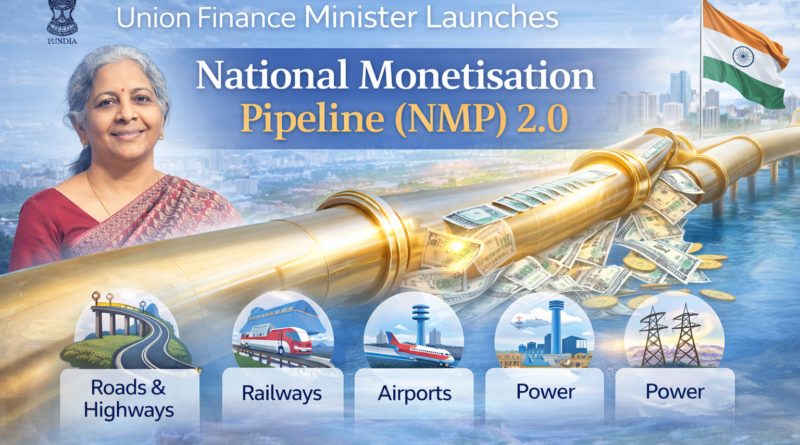
Union Finance Minister Launches National Monetisation Pipeline (NMP) 2.0
In a major step toward strengthening India’s infrastructure financing strategy, the Union Finance Minister has launched the National Monetisation Pipeline (NMP) 2.0. The initiative aims to unlock value from public sector assets, attract private investment, and accelerate infrastructure development across the country.
NMP 2.0 builds upon the foundation laid by the earlier monetisation framework and seeks to expand its scope with improved transparency, efficiency, and sectoral coverage.
What is the National Monetisation Pipeline (NMP)?
The National Monetisation Pipeline (NMP) is a government initiative designed to:
- Monetise underutilised or brownfield public assets
- Raise capital for new infrastructure projects
- Improve asset efficiency and management
- Encourage private sector participation
- Reduce the financial burden on the government
Instead of selling assets outright, monetisation typically involves leasing public infrastructure assets to private players for a fixed period while ownership remains with the government.
What’s New in NMP 2.0?
The newly launched NMP 2.0 aims to enhance the scale and effectiveness of asset monetisation. Key highlights include:
1. Expanded Asset Base
More sectors and asset classes are expected to be included under NMP 2.0, broadening the monetisation strategy.
2. Strengthened Private Participation
The initiative focuses on attracting greater domestic and foreign investment into infrastructure.
3. Improved Transparency
Enhanced monitoring systems and reporting mechanisms will ensure greater accountability in asset monetisation.
4. Focus on Long-Term Value Creation
NMP 2.0 emphasizes efficient asset utilization rather than short-term revenue generation.
5. Integration with Infrastructure Vision
The pipeline aligns with major national programs like PM Gati Shakti and India’s long-term infrastructure roadmap.
Why is NMP 2.0 Important?
India requires significant investment in infrastructure to sustain economic growth. By monetising existing public assets, the government can:
- Generate non-tax revenue
- Fund greenfield infrastructure projects
- Reduce fiscal pressure
- Improve operational efficiency
- Enhance service delivery
This strategy ensures that public assets are productively used while maintaining government ownership.
Sectors Likely to Benefit
NMP 2.0 is expected to focus on several key sectors, including:
- Roads and highways
- Railways
- Airports
- Ports
- Power transmission
- Warehousing and logistics
- Telecom infrastructure
These sectors are critical to improving connectivity, trade, and economic productivity.
How Does Asset Monetisation Work?
Under asset monetisation:
- The government identifies revenue-generating assets.
- Private players are invited to bid for operational rights.
- The private entity manages and operates the asset for a fixed tenure.
- Revenue generated is shared as per agreement.
- Ownership remains with the government.
This model ensures professional management while unlocking capital for future projects.
Economic Impact of NMP 2.0
The launch of NMP 2.0 is expected to:
- Boost investor confidence
- Accelerate infrastructure expansion
- Create employment opportunities
- Strengthen public-private partnerships
- Improve India’s global competitiveness
By leveraging existing assets, India aims to create a sustainable funding model for its ambitious infrastructure plans.
Conclusion
The launch of the National Monetisation Pipeline (NMP) 2.0 marks a significant milestone in India’s economic reform journey. By unlocking the potential of public assets, the government aims to fund future infrastructure growth without increasing fiscal strain.
As India continues its push toward becoming a $5 trillion economy, initiatives like NMP 2.0 will play a crucial role in ensuring balanced, sustainable, and investment-driven development.