
Why Is Emotional Awareness More Powerful Than Emotional Control?
Many people believe quitting the rat race means leaving their job, moving to the mountains, or rejecting ambition altogether. In reality, the rat race is not external — it is internal.
The constant urge to achieve more, avoid discomfort, and suppress emotions keeps us mentally exhausted. Practising composure helps us step out of this cycle by learning how to acknowledge emotions without being ruled by them.
What Is Composure in Emotional Well-Being?
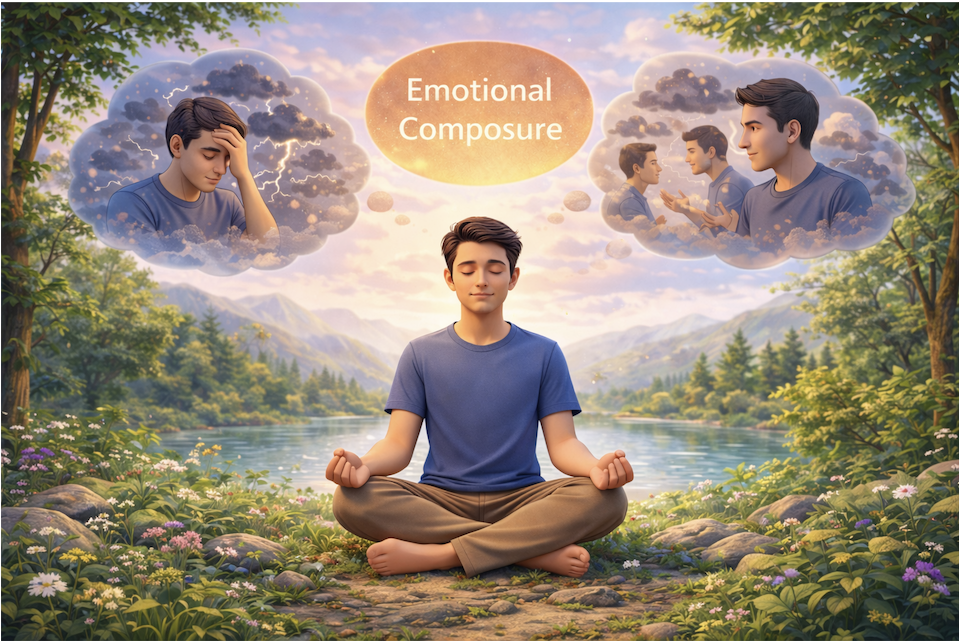
Composure is the ability to stay present with your emotions without reacting impulsively or suppressing them.
It does not mean:
- Ignoring feelings
- Acting emotionless
- Forcing positivity
Instead, composure means:
- Allowing emotions to arise
- Observing them without judgment
- Letting them pass without creating mental stories
This emotional balance creates inner stability — regardless of success or failure.
Why Ignoring Feelings Creates Mental Stress
When emotions are ignored, they don’t disappear. They accumulate.
Unprocessed emotions often show up as:
- Anxiety and restlessness
- Emotional numbness
- Burnout and irritability
- Constant overthinking
Mental peace does not come from control — it comes from acknowledgment.
How Emotional Reactivity Fuels the Rat Race
The rat race thrives on emotional extremes:
- Success creates attachment and craving for more
- Failure creates fear and avoidance
- Comparison creates dissatisfaction
Without emotional awareness, we keep chasing outcomes to feel “enough.” Practising composure helps us break this loop by reducing emotional reactivity.
How to Practise Composure in Daily Life (Simple Steps)
1. Pause When an Emotion Arises
Notice the feeling without labeling it as good or bad.
2. Feel Without Escaping
Don’t distract yourself immediately. Stay present for a few breaths.
3. Avoid Mental Storytelling
Thoughts like “This will never end” intensify suffering. Observe, don’t dramatise.
4. Respond After Awareness
Once the emotion settles, act from clarity — not impulse.
These small practices build emotional resilience over time.
Acknowledge Your Feelings Without Letting Them Control You
Acknowledging emotions is not weakness. It is self-respect.
When you allow emotions to be felt fully:
- They lose their power
- They stop defining your identity
- They pass naturally
This is the foundation of inner composure.
True Freedom Is Emotional Balance
Quitting the rat race does not require abandoning ambition. It requires freedom from emotional compulsion.
When you no longer chase validation or escape discomfort, life becomes simpler, calmer, and more meaningful.
Composure is not about controlling life —
It is about meeting life as it is.