
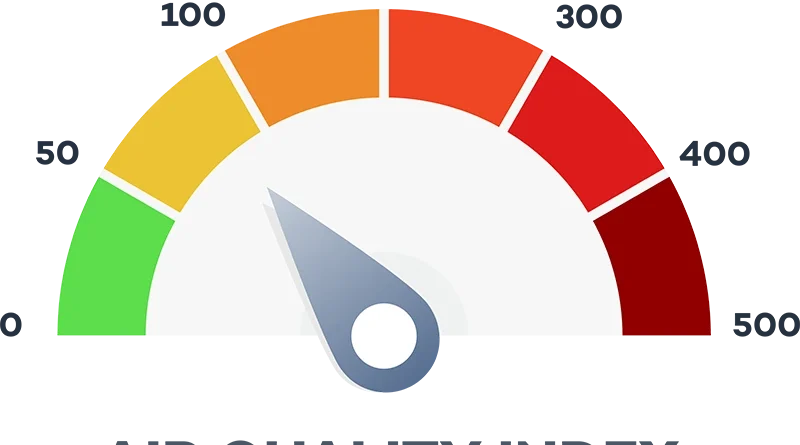
AQI Levels Meaning Chart: What Is a Good or Bad Air Quality Index?
Air quality can change throughout the day. Sometimes, the sky may look clear even when harmful pollutants are present in the air.
This is where the Air Quality Index (AQI) becomes useful.
AQI turns air pollution measurements into an easy-to-understand number. In India, the National Air Quality Index uses six categories ranging from Good (0–50) to Severe (401–500).
Understanding the AQI levels meaning chart can help you decide when to exercise outdoors, when children should reduce prolonged outdoor activities, and when you may need additional protection from air pollution.
What Is AQI?
AQI stands for Air Quality Index.
It is a system used to show how polluted the air is and what the possible health effects may be.
India’s Central Pollution Control Board (CPCB) uses six main AQI categories:
Good → Satisfactory → Moderate → Poor → Very Poor → Severe
Here, Poor and Very Poor are official names of AQI categories. They describe air quality and do not refer to a group of people.
The basic rule is simple:
The lower the AQI, the better the air quality. As the AQI rises, potential health concerns generally increase.
AQI is particularly useful because you cannot always see air pollution. Some of the particles that can affect health are extremely small.
AQI Levels Meaning Chart in India
Here is the Indian AQI levels meaning chart and the general health impact associated with each category.
| AQI Level | Air Quality Category | General Health Meaning |
|---|---|---|
| 0–50 | Good | Minimal health impact |
| 51–100 | Satisfactory | Minor breathing discomfort may occur in sensitive people |
| 101–200 | Moderate | May cause breathing discomfort in people with lung, asthma or heart conditions |
| 201–300 | Poor | May cause breathing discomfort in most people after prolonged exposure |
| 301–400 | Very Poor | May cause respiratory illness after prolonged exposure |
| 401–500 | Severe | Can affect healthy people and seriously affect people with existing health conditions |
These categories are part of India’s National Air Quality Index system.
AQI 0–50: Good
An AQI between 0 and 50 is classified as Good.
This is the best category on India’s AQI scale. The CPCB associates this range with minimal health impact.
For most people, normal outdoor activities can generally continue without special pollution-related precautions.
However, AQI is not the only factor that determines whether outdoor activity is suitable. Weather, temperature and individual health conditions can also matter.
AQI 51–100: Satisfactory
An AQI between 51 and 100 is classified as Satisfactory.
Air quality remains relatively acceptable. However, sensitive people may experience minor breathing discomfort.
Most healthy people can generally continue their normal activities.
People who are particularly sensitive to air pollution should pay attention to any symptoms they experience.
AQI 101–200: Moderate
An AQI between 101 and 200 falls into India’s Moderate category.
At this level, people with asthma, lung conditions or heart conditions may experience breathing discomfort.
Therefore, people who are particularly sensitive to air pollution may want to reduce prolonged or strenuous outdoor activity if they experience symptoms.
An AQI above 100 does not mean everyone must stay indoors. Instead, consider your health, the duration of exposure and the activity you are planning.
AQI 201–300: Poor
An AQI between 201 and 300 is officially classified as Poor under India’s AQI system.
At this point, air pollution becomes more concerning.
Prolonged exposure may cause breathing discomfort in most people. Therefore, consider reducing unnecessary long periods outdoors, particularly if air quality remains in this category for several hours or days.
Children, older adults and people with existing respiratory or cardiovascular conditions may need additional precautions.
AQI 301–400: Very Poor
An AQI between 301 and 400 means the air quality is officially classified as Very Poor.
Prolonged exposure at this level may contribute to respiratory illness.
Consider reducing activities that require heavy breathing outdoors, such as running or intense exercise.
When outdoor pollution is very high, moving your workout indoors to a location with cleaner air can reduce exposure.
People with asthma or other respiratory conditions should continue following the treatment or management plan recommended by their healthcare professional.
AQI 401–500: Severe
An AQI between 401 and 500 falls into the Severe category.
This is the highest category in India’s National AQI system.
Severe air quality can affect healthy people and may have more serious effects on people with existing health conditions.
Reducing unnecessary outdoor exposure becomes particularly important at these levels.
If you must spend time outdoors when particulate pollution is high, a properly fitting particulate respirator, such as an N95-type respirator, may help reduce exposure to airborne particles.
However, a respirator does not eliminate all air pollution risks and does not protect against every type of gaseous pollutant.
Is AQI 50 Good?
Yes.
An AQI between 0 and 50 is Good under India’s AQI system.
It represents the lowest pollution-related health-impact category.
Therefore, AQI 50 is generally much more favourable for outdoor activities than AQI 200, 300 or 400.
Is AQI 100 Good or Bad?
AQI 51–100 is Satisfactory in India.
Therefore, AQI 100 sits at the upper end of the Satisfactory category.
Once the AQI rises above 100, it enters the Moderate category.
For most healthy adults, AQI around 100 is very different from AQI 300 or 400. However, people who are particularly sensitive to pollution may notice symptoms at lower levels.
Is AQI 150 Safe?
AQI 150 is Moderate under India’s AQI scale.
It does not mean the air is immediately dangerous for everyone.
However, people with asthma, lung conditions or heart conditions may experience breathing discomfort.
If you are particularly sensitive to air pollution, consider reducing prolonged strenuous activity outdoors when you experience symptoms.
Is AQI 200 Dangerous?
AQI 200 is at the upper end of the Moderate category.
AQI 201 begins the official Poor category.
As pollution approaches and exceeds this level, prolonged outdoor exposure becomes more concerning.
Therefore, pay closer attention to both the AQI and how much time you plan to spend outside.
Is AQI 300 Dangerous?
AQI 300 is at the upper end of the Poor category.
AQI 301 begins the Very Poor category.
At these pollution levels, reducing prolonged outdoor exposure is sensible, particularly for children, older adults and people with existing respiratory or cardiovascular conditions.
Strenuous exercise can also increase exposure because you breathe faster and more deeply while exercising.
Is AQI 400 Dangerous?
Yes. AQI 400 sits at the upper end of India’s Very Poor category.
AQI 401 begins the Severe category.
At this point, unnecessary prolonged outdoor exposure should be reduced where practical.
Pay particular attention to local health advisories and any symptoms you experience.
Is AQI 500 Dangerous?
Yes.
AQI 401–500 is Severe under India’s AQI system.
Severe air quality can affect healthy people and may have a more serious impact on people with existing conditions.
An AQI close to 500 should therefore not be treated as a normal pollution day.
Follow local health advisories and reduce exposure where reasonably possible.
What Does PM2.5 Mean?
You will often see PM2.5 when checking air quality.
PM stands for particulate matter. PM2.5 refers to particles with a diameter of 2.5 micrometres or smaller.
These particles are particularly concerning because they can travel deep into the lungs. Some fine particles can also enter the bloodstream.
Common sources of particulate pollution can include vehicle emissions, industrial activity, power generation, construction, fires and fuel combustion. However, the major sources can differ considerably between locations.
What Is PM10?
PM10 is another type of particulate matter.
It refers to inhalable particles with diameters of 10 micrometres or smaller.
PM10 can include particles from road dust, construction activity and other sources.
Both PM2.5 and PM10 contribute to air pollution, but PM2.5 receives particular attention because its smaller size allows it to penetrate deeper into the respiratory system.
AQI vs PM2.5: What’s the Difference?
AQI and PM2.5 are related, but they are not the same thing.
PM2.5 refers to a particular type of air pollutant.
AQI is an index designed to communicate air-quality conditions and potential health effects in a simpler format.
Think of it this way:
PM2.5 = a type of pollutant
AQI = an air-quality rating
Therefore, a PM2.5 concentration should not automatically be interpreted as the same number as an AQI reading.
Which Pollutants Are Included in India’s AQI?
India’s National AQI considers several major air pollutants.
These include:
- PM2.5
- PM10
- Nitrogen dioxide (NO₂)
- Sulphur dioxide (SO₂)
- Carbon monoxide (CO)
- Ozone (O₃)
- Ammonia (NH₃)
- Lead (Pb)
Therefore, two cities with the same overall AQI may not necessarily have exactly the same mixture of pollutants.
Why Does AQI Change Throughout the Day?
AQI can rise and fall throughout the day because air pollution is constantly changing.
Several factors can affect local air quality, including traffic, construction, industrial emissions, fires, wind, rainfall, temperature and atmospheric conditions.
For example, wind can sometimes help disperse pollutants. On the other hand, certain weather conditions can trap pollution closer to the ground.
Traffic levels can also change considerably between morning, afternoon and evening.
Therefore, the AQI you see in the morning may not be the same later in the day.
Who Should Be Extra Careful When AQI Is High?
Air pollution can affect everyone, but some people can be more vulnerable.
These can include:
- Children
- Older adults
- Pregnant people
- People with asthma
- People with other respiratory conditions
- People with cardiovascular conditions
- People with other chronic health conditions
Children deserve particular attention because their lungs and other organs are still developing.
People with asthma or other respiratory conditions should also pay close attention to changes in their symptoms when pollution increases.
If you have a medical condition that can be affected by air pollution, follow advice from your healthcare professional.
What Should You Do When AQI Is High?
You cannot directly control outdoor AQI, but you can reduce how much polluted air you breathe.
When air pollution becomes high, consider reducing prolonged strenuous outdoor activities.
If possible, exercise away from congested roads and other obvious pollution sources.
During periods of high outdoor particulate pollution, spending more time in a cleaner indoor environment can reduce exposure.
You can also reduce indoor sources of pollution, including tobacco smoke and unnecessary burning.
If you must go outdoors during heavy particulate pollution, an appropriately fitting particulate respirator can help reduce exposure to airborne particles.
Should You Exercise When AQI Is High?
Exercise remains important for overall health.
However, vigorous exercise makes you breathe faster and more deeply. This can increase the amount of polluted air you inhale.
Therefore, when AQI is particularly high, consider changing the time, location or intensity of your workout.
For example, you could move a run away from a heavily congested road or exercise indoors when cleaner indoor air is available.
People with existing respiratory or cardiovascular conditions may need more individualized advice.
Can an N95 Mask Protect You From Air Pollution?
A properly fitted N95-type respirator can reduce exposure to airborne particulate matter.
However, fit is important.
Large gaps around the nose or sides of the face can allow unfiltered air to enter.
Also remember that an N95-type particulate respirator does not provide universal protection against all gaseous air pollutants.
Therefore, wearing a respirator should not be treated as permission to spend unlimited time in severely polluted air.
Reducing exposure remains important.
Should You Close Windows When AQI Is High?
When outdoor pollution is high, closing windows and doors can help reduce the amount of outdoor pollution entering your home.
However, indoor air quality also matters.
Cooking smoke, tobacco smoke, incense, candles and other indoor sources can increase pollution inside a home.
Therefore, the best approach depends on both indoor and outdoor conditions.
When outdoor air quality improves, ventilation may help replace stale indoor air where appropriate.
Do Air Purifiers Help When AQI Is High?
An appropriate portable air cleaner can reduce particulate pollution in the room where it operates.
However, the purifier needs to be suitable for the size of the room.
Filters also need to be cleaned or replaced according to the manufacturer’s instructions.
An air purifier cannot completely protect you from all pollutants, and it should not replace reducing pollution at its source.
Can Food or Drinks Detox Your Lungs After Pollution?
Be careful with claims about “lung detox” drinks, teas or foods.
There is no special juice, herb or food that simply removes all pollution particles from your lungs.
Eating a balanced diet, staying physically active, getting enough sleep and drinking sufficient fluids can support general health.
However, these habits are not substitutes for reducing exposure to polluted air.
The most practical approach is to reduce how much polluted air you breathe in the first place.
Indian AQI vs US AQI
AQI systems are not identical around the world.
Different countries can use different pollutant breakpoints, calculation methods and category names.
India uses:
Good → Satisfactory → Moderate → Poor → Very Poor → Severe
The United States uses a different category system.
Therefore, when checking pollution in India, use the Indian AQI chart rather than automatically applying an AQI chart designed for another country.
Where Can You Check AQI in India?
For official Indian air-quality information, you can use the Central Pollution Control Board’s National AQI service.
Check India’s AQI – Central Pollution Control Board
Checking AQI before planning prolonged outdoor activities can be particularly useful during periods of elevated pollution.
Frequently Asked Questions
What is a good AQI level?
In India, AQI 0–50 is classified as Good. This is the lowest health-impact category in the National AQI system.
Is AQI 100 safe?
AQI 100 is at the upper end of India’s Satisfactory category. People who are particularly sensitive to air pollution should still pay attention to symptoms.
What does AQI 150 mean?
AQI 150 falls into the Moderate category.
What does AQI 200 mean?
AQI 200 is the upper boundary of the Moderate category. AQI 201 begins the Poor category.
What does AQI 300 mean?
AQI 300 is the upper boundary of the Poor category. AQI 301 begins the Very Poor category.
What does AQI 400 mean?
AQI 400 is the upper boundary of the Very Poor category. AQI 401 begins the Severe category.
What does AQI 500 mean?
AQI 500 is within India’s Severe category and represents extremely polluted air.
Is a lower AQI better?
Yes. In general, lower AQI means better air quality and lower pollution-related health concern.
Can high AQI affect healthy people?
Yes. Very high pollution levels can affect people without existing medical conditions as well.
What is the difference between AQI and PM2.5?
PM2.5 is a type of fine particulate pollutant. AQI is an index used to communicate overall air-quality conditions and potential health effects.
Conclusion
Understanding the AQI levels meaning chart makes air-quality information much easier to use.
In India’s National Air Quality Index:
0–50 = Good
51–100 = Satisfactory
101–200 = Moderate
201–300 = Poor
301–400 = Very Poor
401–500 = Severe
Remember that Poor and Very Poor are official air-quality category names.
The main rule is simple: lower AQI is generally better.
As AQI rises, especially into the Poor, Very Poor and Severe categories, consider reducing unnecessary exposure and prolonged strenuous outdoor activity.
Children, older adults, pregnant people and people with existing health conditions may need additional precautions when pollution levels are elevated.
Rather than judging pollution by how the sky looks, check the current AQI before planning lengthy outdoor activities.