


Can You Free Yourself from Pain by Consistently Observing Your Mind Without Judging Your Thoughts?
Pain is a natural part of being human. But much of the suffering we experience doesn’t come from events themselves—it comes from how our mind reacts to them. This raises an important question: Can we reduce pain by simply observing our thoughts without judging them?
The answer, supported by psychology, mindfulness practices, and ancient wisdom, is yes—with consistent awareness and patience.
Understanding the Difference Between Pain and Suffering
Pain is often immediate and unavoidable—a loss, a failure, a difficult memory.
Suffering, however, is what happens when the mind repeatedly revisits that pain.
- Replaying old conversations
- Imagining worst-case futures
- Judging ourselves for having certain thoughts
When we don’t observe our thoughts, they quietly control our emotional state.
What Does It Mean to Observe the Mind?
Observing the mind means noticing thoughts as they arise without reacting to them.
Instead of:
“Why am I thinking this? This is wrong.”
You gently say:
“A thought is happening.”
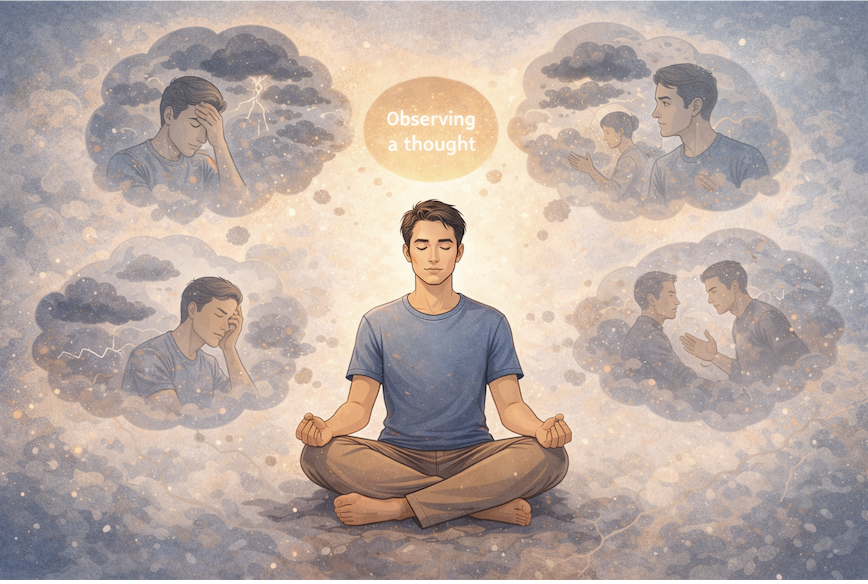
You are not trying to stop thoughts. You are simply watching them—like clouds passing through the sky.
This practice creates space between you and your thoughts, and in that space, pain begins to soften.
Why Judging Thoughts Increases Pain
Judgment adds a second layer of suffering.
For example:
- Feeling anxious → normal
- Judging yourself for feeling anxious → added pain
When you label thoughts as bad, weak, or wrong, the mind resists them—and resistance strengthens emotional discomfort.
Observation without judgment allows thoughts to rise and fall naturally.
How Consistent Observation Reduces Pain Over Time
At first, observing your thoughts may feel uncomfortable. But with consistency, something powerful happens:
- Thoughts lose emotional charge
- Reactions become slower and calmer
- You stop identifying with every mental story
You realize:
I have thoughts, but I am not my thoughts.
This shift doesn’t eliminate pain completely—but it prevents pain from turning into prolonged suffering.
Practical Ways to Practice Non-Judgmental Observation
1. Pause and Notice
When a strong emotion arises, pause for a moment and silently observe what the mind is saying.
2. Name Without Blame
Instead of analyzing, gently label:
- “Worrying”
- “Remembering”
- “Planning”
3. Return to the Body
Bring attention to your breath or physical sensations. This anchors awareness in the present moment.
4. Practice Daily Stillness
Even 5 minutes of quiet observation each day builds mental clarity and emotional resilience.
Can This Practice Completely Free You from Pain?
The goal is not to eliminate pain—it is to stop adding unnecessary suffering.
Life will still bring challenges. But when you observe your mind instead of fighting it:
- Pain becomes lighter
- Emotions pass more quickly
- Inner peace becomes more accessible
Freedom comes not from controlling thoughts, but from no longer being controlled by them.
Final Reflection
Consistently observing your mind without judgment is a gentle but powerful practice. Over time, it teaches you that peace doesn’t come from changing your thoughts—it comes from changing your relationship with them.
When awareness replaces judgment, pain loses its grip.