
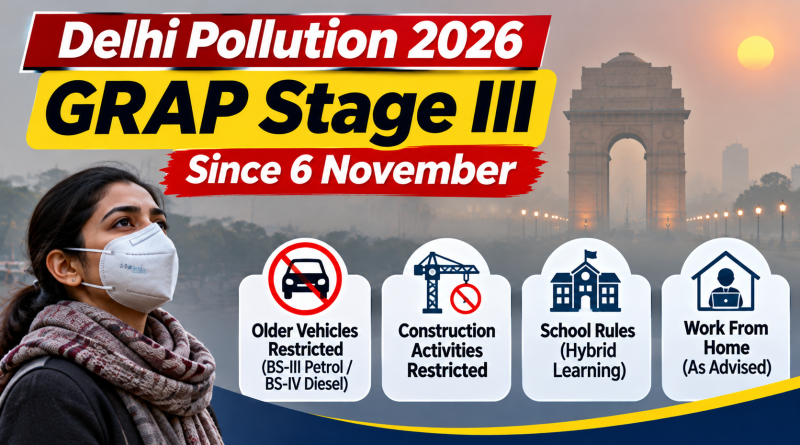
Delhi Pollution 2026: GRAP Stage III Restrictions Continue, Vehicle Ban and School Rules Explained
Delhi pollution 2026 remains a major concern as the national capital continues to face poor air quality in November.
The Commission for Air Quality Management (CAQM) introduced GRAP Stage III restrictions on November 6, 2026, across Delhi and the National Capital Region (NCR).
The decision came after Delhi’s Air Quality Index (AQI) reached 382, which falls in the very poor category.
However, weather forecasts suggested that pollution could enter the severe category. Therefore, authorities introduced stricter measures before conditions became worse.
As of November 11, GRAP Stage III remains active.
The restrictions affect older vehicles, construction activities, schools and certain commercial operations.
Here is everything residents need to know about the latest Delhi pollution restrictions.
Delhi Pollution 2026: Latest GRAP Stage III Update
Delhi-NCR has been experiencing worsening air quality since late October.
Authorities first introduced GRAP Stage I on October 21.
Next, Stage II came into force on November 2.
However, pollution levels continued to rise.
As a result, CAQM activated Stage III on November 6.
Delhi GRAP Stage III: Key Highlights
| Details | Latest information |
|---|---|
| Location | Delhi-NCR |
| GRAP Stage III start date | November 6, 2026 |
| Current status | Active as of November 11 |
| AQI when announced | 382 |
| Main reason | Worsening pollution and severe AQI forecasts |
| Older vehicle restrictions | Applicable |
| Construction restrictions | Applicable |
| School rules | Hybrid learning for specified classes |
| Authority | CAQM |
The restrictions will remain in place until CAQM issues an order changing or withdrawing them.
Why Was GRAP Stage III Imposed in Delhi?
The government uses the Graded Response Action Plan to control air pollution.
GRAP introduces different measures depending on pollution levels and forecasts.
On November 6, Delhi’s AQI reached 382.
Although this was below the usual Stage III threshold, forecasts suggested that air quality could worsen further.
Therefore, CAQM decided to introduce preventive restrictions.
The aim was to reduce pollution before conditions became more dangerous.
What Is GRAP Stage III?
GRAP stands for Graded Response Action Plan.
It includes several levels of pollution-control measures.
Each stage introduces additional restrictions.
GRAP Stages and AQI Levels
| Stage | AQI range | Air quality |
|---|---|---|
| Stage I | 201–300 | Poor |
| Stage II | 301–400 | Very Poor |
| Stage III | 401–450 | Severe |
| Stage IV | Above 450 | Severe Plus |
However, authorities can activate a stage early when forecasts indicate that pollution will worsen.
Therefore, the active GRAP stage does not always match the current AQI category.
1. Delhi Pollution 2026: BS3 Petrol and BS4 Diesel Vehicle Ban
One of the most important GRAP Stage III restrictions affects older vehicles.
Under the rules, BS-III petrol and BS-IV diesel light motor vehicles cannot operate in specified areas.
The restriction covers Delhi and the following NCR districts:
- Gurugram
- Faridabad
- Ghaziabad
- Gautam Buddh Nagar, including Noida and Greater Noida
- Sonipat
The September 2026 GRAP revision added Sonipat to the areas covered by this restriction.
Which Vehicles Are Restricted?
| Vehicle type | Stage III position |
|---|---|
| BS-III petrol cars | Restricted in specified areas |
| BS-IV diesel cars | Restricted in specified areas |
| BS-VI petrol cars | Generally permitted, subject to other rules |
| BS-VI diesel cars | Generally permitted, subject to other rules |
| Electric vehicles | Generally permitted |
| CNG vehicles | Generally permitted |
Certain exemptions may apply under official directions.
Therefore, drivers should check local traffic advisories before travelling.
2. Restrictions on Commercial Vehicles Entering Delhi
Commercial vehicles also face additional restrictions.
Under Stage III, certain non-Delhi registered diesel goods vehicles are restricted from entering the capital.
In addition, Delhi has introduced separate restrictions on older vehicles registered outside the city.
These rules apply alongside GRAP measures.
Therefore, vehicle owners must check both the current GRAP stage and Delhi’s border-entry requirements.
Commercial operators should also ensure that their vehicles meet the required emission standards.
3. Construction and Demolition Restrictions
Construction dust is an important source of particulate pollution.
Therefore, GRAP Stage III restricts non-essential construction and demolition activities that generate dust.
These include several activities involving excavation, demolition and material handling.
However, certain essential projects may continue under the applicable exemptions and dust-control conditions.
For example, specific public infrastructure and emergency projects may receive exemptions.
Even exempt projects must follow pollution-control requirements.
What Activities Face Restrictions?
Common restricted activities include:
- Non-essential demolition work
- Dust-generating excavation
- Certain earthwork activities
- Open-air operations at ready-mix concrete plants
- Other dust-generating construction activities covered by the GRAP schedule
However, the revised 2026 schedule allows certain minor activities, such as pothole repairs, under specified conditions.
4. Delhi School Rules Under GRAP Stage III
Air pollution can affect children, especially those with breathing problems.
Therefore, GRAP Stage III includes measures for schools.
Under the framework, schools up to Class V must follow hybrid learning arrangements as directed.
Hybrid learning means students may have access to both physical and online classes.
However, parents should follow the latest instructions from their school and education department.
A Stage III order does not automatically mean every school in Delhi-NCR must close.
5. Work From Home Rules for Offices
GRAP Stage III also allows authorities to consider reducing attendance at offices.
For example, state governments may decide whether certain public, municipal and private offices should operate with 50% physical attendance.
The remaining employees may work from home where permitted.
However, this is not an automatic work-from-home order for every employee.
The final arrangement depends on government directions and the employer’s applicable instructions.
6. Industrial and Dust-Control Measures
Authorities must also enforce pollution-control rules at industrial and commercial sites.
For example, units must follow the fuel and emission requirements that apply to their operations.
In addition, agencies may increase inspections and dust-control activities.
Road sweeping and water sprinkling can help reduce loose dust.
However, these measures work best when combined with controls on major pollution sources.
7. Why Delhi Pollution Increases During November
Delhi often experiences poor air quality during the winter season.
Several factors contribute to the problem.
Vehicle Emissions
Cars, buses and trucks release pollutants.
Heavy traffic can increase local pollution levels.
Road and Construction Dust
Dust from roads, building sites and open areas adds to particulate pollution.
Agricultural Burning
Crop residue burning in surrounding regions can contribute to pollution during certain periods.
However, its contribution changes with weather and burning activity.
Weather Conditions
Low wind speeds and reduced atmospheric mixing can trap pollutants near the ground.
As a result, pollution may remain in the air for longer.
Firecracker Smoke
Firecrackers can cause short-term increases in particulate pollution.
However, they are only one of several sources affecting Delhi’s air quality.
8. Delhi AQI: What Do the Numbers Mean?
AQI helps people understand the level of air pollution.
India uses six main categories.
| AQI | Category |
|---|---|
| 0–50 | Good |
| 51–100 | Satisfactory |
| 101–200 | Moderate |
| 201–300 | Poor |
| 301–400 | Very Poor |
| 401–500 | Severe |
Higher AQI levels generally indicate greater health concerns.
For example, people with asthma or other respiratory conditions may experience more symptoms when pollution becomes severe.
Therefore, residents should check air quality before planning long outdoor activities.
9. Health Effects of Delhi Air Pollution
Air pollution can affect people of all ages.
However, some groups face higher risks.
These include children, older adults, pregnant women and people with heart or lung conditions.
Common symptoms associated with pollution exposure may include:
- Eye irritation
- Coughing
- Throat irritation
- Breathing discomfort
- Worsening asthma symptoms
People with severe breathing problems or chest pain should seek medical attention.
10. How to Protect Yourself During GRAP Stage III
Residents can take several steps to reduce exposure.
Check AQI Before Going Outside
Start by checking the latest local air-quality reading.
Reduce Outdoor Exercise
When pollution is severe, consider moving intense exercise indoors.
Use a Well-Fitting N95 Mask
A genuine, properly fitted N95 respirator can reduce exposure to airborne particles.
However, it does not filter every harmful gas.
Reduce Indoor Pollution
Avoid smoking indoors, burning waste or creating unnecessary smoke.
Also, use kitchen ventilation appropriately.
Consider an Air Purifier
A suitable air purifier with effective particle filtration may help reduce indoor PM2.5.
However, choose a model based on room size and cleaning capacity.
11. Does GRAP Stage III Apply to Noida and Gurugram?
Yes. CAQM activated Stage III measures across the National Capital Region.
However, some restrictions apply only to specified locations or vehicle categories.
For example, the older petrol and diesel light-vehicle restrictions cover Delhi and selected nearby districts.
Therefore, residents should check local enforcement notices.
12. When Will GRAP Stage III Be Removed?
There is no fixed date for withdrawing Stage III restrictions.
CAQM reviews air quality, weather forecasts and pollution trends.
If conditions improve, the commission may withdraw Stage III.
However, Stage I or Stage II measures may remain active.
Therefore, a temporary improvement in AQI does not automatically end the restrictions.
13. How to Check the Latest Delhi Pollution and GRAP Status
Residents should use official sources for updates.
Commission for Air Quality Management
CAQM publishes GRAP orders and pollution-control directions.
Central Pollution Control Board
CPCB provides air-quality readings from monitoring stations.
Delhi Environment Department
The department publishes environmental notifications and advisories.
Frequently Asked Questions
Is GRAP Stage III active in Delhi on November 11, 2026?
Yes. CAQM’s official dashboard lists Stage III as active, effective from November 6, 2026.
Why was GRAP Stage III imposed on November 6?
Delhi’s AQI reached 382, and forecasts indicated that pollution could enter the severe category.
Are BS3 petrol cars banned in Delhi?
BS-III petrol light motor vehicles face restrictions under Stage III in Delhi and specified NCR districts, subject to applicable exemptions.
Are BS4 diesel cars allowed in Delhi?
BS-IV diesel light motor vehicles are restricted under Stage III in the covered areas, subject to official exemptions.
Are schools closed under GRAP Stage III?
Not necessarily. Hybrid learning applies to specified classes under the framework. Follow the latest school and education department directions.
Is work from home compulsory in Delhi?
Not automatically. Governments may issue directions for reduced office attendance, but the rules depend on the applicable orders.
Are construction activities banned?
Stage III restricts many non-essential dust-generating construction and demolition activities. Certain essential projects may be exempt.
When will GRAP Stage III end?
CAQM will decide when to withdraw the restrictions based on air quality and forecasts.
Conclusion
Delhi pollution 2026 has led to stricter GRAP Stage III restrictions across the National Capital Region.
The measures began on November 6 after worsening air quality and forecasts of severe pollution.
The restrictions affect older vehicles, construction activities, schools and certain commercial operations.
As of November 11, Stage III remains active.
Therefore, residents should follow official directions, check local AQI readings and reduce unnecessary exposure to polluted air.
For the latest information, visit the CAQM website and follow official government advisories.