


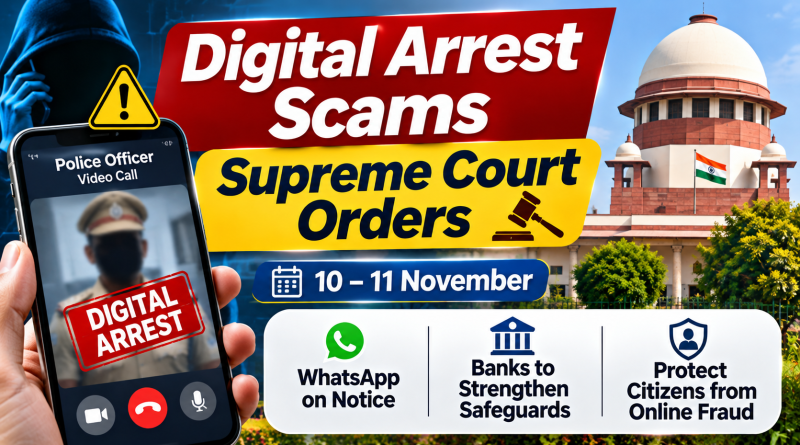
Digital Arrest Scam 2026: Supreme Court Orders WhatsApp, Banks and Police to Act
Digital arrest scams in India have prompted fresh directions from the Supreme Court as authorities work to protect people from online fraud.
On November 10 and 11, 2026, reports highlighted an important Supreme Court order concerning fake police calls, WhatsApp scams and financial fraud.
The Court asked WhatsApp and other online platforms to explain how they plan to prevent digital arrest scams.
In addition, it directed law enforcement agencies across India to submit reports on registered cases and investigations.
The Supreme Court also raised concerns about banks failing to detect suspicious transactions.
The next hearing is scheduled for November 23, 2026.
Here is what the Supreme Court ordered, how digital arrest fraud works and what victims should do.
Digital Arrest Scam 2026: Latest Supreme Court Update
The Supreme Court is examining digital arrest scams through a case it initiated on its own.
The case is titled In Re: Victims of Digital Arrest Related to Forged Documents.
A bench comprising Chief Justice Surya Kant, Justice Joymalya Bagchi and Justice V Mohana issued directions in an order dated October 29, 2026.
The order became a major news development on November 10.
Key Highlights
| Details | Information |
|---|---|
| Issue | Digital arrest scams and cyber fraud |
| Court | Supreme Court of India |
| Order date | October 29, 2026 |
| News update | November 10–11, 2026 |
| Asked to submit anti-fraud measures | |
| RBI | Directed to provide a list of authorised financial institutions |
| State police | Asked to report FIRs and investigations |
| Banking safeguards | Suspicious transaction checks and victim protection |
| Next hearing | November 23, 2026 |
The directions aim to improve fraud prevention and coordination between banks, police and digital platforms.
1. Supreme Court Asks WhatsApp to Prevent Digital Arrest Scams
One of the most important developments concerns WhatsApp.
Fraudsters often use messaging apps and video calls to impersonate police officers.
Therefore, the Supreme Court has asked WhatsApp and other concerned platforms to explain what measures they propose to prevent such scams.
The companies must also share their proposals with the Indian Cyber Crime Coordination Centre, known as I4C.
What Has WhatsApp Done So Far?
During the proceedings, WhatsApp’s representative informed the Court that the platform had taken action against approximately 9,400 accounts linked to suspicious activity.
The platform also discussed technology intended to identify suspicious accounts and warn users.
However, these measures do not guarantee that every scam account will be detected.
Therefore, users should remain cautious when receiving unexpected calls or messages.
2. Supreme Court Raises Questions About Bank Accountability
The Supreme Court also focused on financial institutions.
Digital arrest scams can involve victims transferring large sums to fraudsters.
In some cases, these transactions may be unusual compared with the customer’s normal banking activity.
The Court questioned whether banks should do more to identify and stop suspicious payments.
For example, banks may need to detect unusually large transfers and take appropriate preventive action.
Can Banks Be Required to Compensate Victims?
The Supreme Court stated that the proposed regulatory framework should provide compensation where a financial institution’s failure to exercise due diligence caused or allowed a cyber fraud.
However, this does not mean every victim automatically receives a refund.
Responsibility would depend on the facts of the case and the applicable legal framework.
Therefore, victims should report fraud promptly and preserve all relevant evidence.
3. RBI Asked to Strengthen Cyber Fraud Safeguards
The Court is also examining proposed changes to the Reserve Bank of India’s Know Your Customer rules.
These are known as the RBI KYC Amendment Directions, 2026.
According to the Supreme Court order, the proposed directions were expected to be notified by November 30 and become operational by December 31, 2026.
However, these were proposed timelines at the time of the order.
The Court also directed the RBI to submit a list of authorised financial institutions before the next hearing.
What Banking Safeguards Are Being Considered?
The Court highlighted measures such as:
- Temporarily holding unusual transactions.
- Alerting authorities about suspicious transfers.
- Verifying certain high-risk transactions.
- Improving coordination between banks and police.
- Creating clearer procedures for victim compensation.
These proposals aim to prevent fraud before victims lose their money.
4. State Police Asked to Submit Digital Arrest Scam Reports
The Supreme Court directed law enforcement agencies across states and Union Territories to provide details of digital arrest scam cases.
The reports must cover registered First Information Reports, commonly called FIRs, and related investigations.
In addition, police agencies must suggest ways to improve prevention and prosecution.
The Directors General of Police of all states and Union Territories must ensure compliance.
The information must also be shared with I4C.
As a result, the Court will receive a broader picture of digital arrest fraud across India.
5. What Is a Digital Arrest Scam?
A digital arrest scam is a type of cyber fraud in which criminals pretend to be police officers or government officials.
They may contact a victim through a phone call, WhatsApp or another video-calling platform.
Next, they claim that the victim is involved in a criminal case.
For example, they may falsely accuse someone of money laundering, drug trafficking or illegal financial activity.
The fraudsters then create fear by threatening immediate arrest.
Sometimes, they ask the victim to remain on a video call for several hours.
Finally, they demand money to settle the supposed case or complete a fake verification process.
Important: There is no legitimate police procedure called digital arrest that requires a person to stay on a video call and transfer money.
6. How Digital Arrest Scams Work
Fraudsters often follow a pattern.
Step 1: Unexpected Phone Call
The victim receives a call from someone claiming to represent the police, CBI, customs or another authority.
Step 2: False Criminal Allegation
The caller claims that the victim’s identity or bank account is linked to a crime.
Step 3: Fake Documents
The scammer may send forged arrest warrants, police notices or government documents.
Step 4: Video Call Pressure
The victim is asked to join a video call.
The scammer may wear a police-style uniform or use a fake official background.
Step 5: Threats and Isolation
The caller tells the victim not to speak with family members or contact the police.
Step 6: Money Demand
The fraudster asks for a transfer to a supposed verification account or safe account.
However, the money goes to accounts controlled by criminals.
7. Common Warning Signs of a Digital Arrest Scam
People should be cautious when a caller:
- Claims that an arrest can happen through WhatsApp.
- Demands money to avoid police action.
- Orders them to remain on a video call.
- Threatens immediate imprisonment.
- Sends suspicious arrest warrants or court documents.
- Asks for OTPs, passwords or banking information.
- Tells them not to contact family or lawyers.
- Requests transfers to a so-called safe account.
These are major warning signs of fraud.
8. Can Police Arrest Someone Through WhatsApp?
No. A WhatsApp video call is not a legal substitute for arrest procedures.
Police officers cannot lawfully place someone under a so-called digital arrest simply by keeping them on a call.
In addition, legitimate authorities do not demand transfers to private accounts to cancel criminal cases.
Therefore, anyone receiving such a demand should end the conversation and verify the claim independently.
Do not rely on phone numbers or links provided by the suspicious caller.
9. What to Do If You Receive a Digital Arrest Call
If you receive a suspicious call, act calmly.
First, disconnect the call.
Next, avoid sharing personal or financial information.
Do not transfer money, even if the caller threatens immediate arrest.
Also, contact your local police station using independently verified contact details.
If the caller used WhatsApp, report and block the account.
Finally, inform family members, especially older relatives who may be unfamiliar with these scams.
10. What to Do If You Have Already Sent Money
Victims should act immediately after discovering a fraudulent transaction.
Call 1930
India operates the national cybercrime helpline at 1930.
Report the incident as soon as possible.
Report the Fraud Online
Visit the National Cyber Crime Reporting Portal:
Submit the relevant transaction details and available evidence.
Contact Your Bank
Immediately notify your bank through its official customer support channel.
Request that the fraudulent transaction be investigated.
Preserve Evidence
Keep screenshots, transaction IDs, phone numbers and chat records.
Do not delete messages that may help investigators.
Follow Police Instructions
If required, file a formal complaint or FIR.
The sooner authorities receive the information, the better the opportunity to trace the money.
However, recovery is not guaranteed.
11. Can Digital Arrest Scam Victims Get Their Money Back?
Money recovery depends on several factors.
These include how quickly the fraud is reported, whether funds remain in the receiving accounts and the results of the investigation.
In some cases, authorities may be able to place holds on suspected fraudulent funds.
However, criminals may move money through several accounts.
Therefore, immediate reporting is important.
The Supreme Court’s latest directions also focus on stronger banking safeguards and accountability.
Still, victims should not assume that compensation is automatic.
12. Why Are Senior Citizens Vulnerable to Digital Arrest Scams?
Fraudsters often use fear and urgency to pressure victims.
Older adults may be especially concerned when someone claims to be a police officer or government official.
In addition, scammers may use forged documents to make their threats appear genuine.
However, people of any age can become targets.
Therefore, families should discuss common cyber fraud methods and encourage relatives to verify suspicious claims.
13. How to Protect Your Family From Cyber Fraud
Awareness is one of the most useful ways to prevent scams.
First, explain that police do not demand money through video calls.
Next, encourage family members to disconnect suspicious calls.
Also, remind them never to share OTPs, banking passwords or screen access.
Keep official banking and emergency contact numbers easily available.
Finally, report suspicious activity rather than ignoring it.
14. What Happens Next in the Supreme Court Case?
The Supreme Court will continue reviewing measures proposed by digital platforms, banks and law enforcement agencies.
The next hearing is scheduled for November 23, 2026.
The Court is expected to examine compliance with its directions and consider further safeguards.
However, the final outcome will depend on subsequent proceedings.
Therefore, readers should follow official court updates rather than assuming that every proposal has already become law.
Official Links for Digital Arrest Scam Complaints
| Purpose | Official website |
|---|---|
| Report cybercrime | https://cybercrime.gov.in/ |
| Cybercrime helpline | 1930 |
| Supreme Court of India | https://www.sci.gov.in/ |
| Reserve Bank of India | https://www.rbi.org.in/ |
| National Cybercrime Reporting Portal | https://cybercrime.gov.in/ |
Frequently Asked Questions
What is the latest Supreme Court order on digital arrest scams?
The Supreme Court has asked WhatsApp and other platforms to propose anti-fraud measures. It has also directed police agencies to submit investigation reports and asked the RBI for information about authorised financial institutions.
When was the Supreme Court digital arrest order issued?
The relevant order was dated October 29, 2026. It received widespread news coverage on November 10–11.
When is the next Supreme Court hearing?
The next hearing is scheduled for November 23, 2026.
Is digital arrest legal in India?
There is no legitimate procedure allowing police to keep someone under digital arrest through a video call and demand money.
Can police demand money to cancel an arrest?
No. A caller demanding money to avoid arrest is displaying a major warning sign of fraud.
What is the cybercrime helpline number in India?
The national cybercrime helpline number is 1930.
Where can I report a digital arrest scam?
You can report it at https://cybercrime.gov.in/ or call 1930.
Can banks compensate digital arrest scam victims?
Compensation depends on the applicable legal rules and the circumstances. The Supreme Court has called for stronger accountability where banks fail to exercise required due diligence.
Has WhatsApp taken action against scam accounts?
During the proceedings, WhatsApp’s representative reported action against approximately 9,400 accounts.
What should I do if someone threatens me with digital arrest?
Disconnect the call, do not transfer money, verify the claim through official channels and report the incident.
Conclusion
Digital arrest scams in India have become an important concern for the Supreme Court.
The Court has directed WhatsApp and other platforms to propose stronger measures against online fraud.
In addition, it has sought information from the RBI and reports from police agencies across the country.
The next hearing is scheduled for November 23, 2026.
Meanwhile, people should remember that no genuine police officer can place them under digital arrest through a video call or demand money to avoid arrest.
If you receive such a call, disconnect immediately.
If you have already lost money, contact your bank, call 1930 and report the fraud through the official cybercrime portal.