


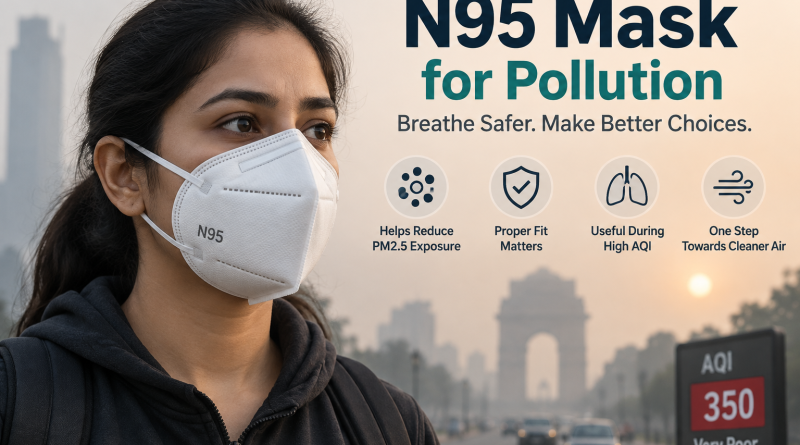
N95 Mask for Pollution: How to Choose the Right Mask for High AQI
When air pollution rises, especially during winter in northern Indian cities, masks quickly return to shops, pharmacies and online marketplaces.
But not every product labelled an “anti-pollution mask” offers the same protection.
If you are considering an N95 mask for pollution, the most important factors are not the colour, brand or appearance. Certification, filtration performance and—most importantly—how well the respirator seals against your face matter much more.
An appropriately certified, well-fitting particulate respirator can reduce your exposure to PM2.5 and other airborne particles. However, an N95 does not remove every pollutant from the air and should not be treated as complete protection against severe air pollution.
Here’s what you should know before buying one.
What Is an N95 Mask?
An N95 is technically a particulate respirator, rather than an ordinary face mask.
The “95” refers to its filtration performance under the relevant certification test.
WHO explains that respirators approved to remove at least 95% of particles include standards such as N95, KN95 and FFP2, although they are certified under different systems.
An important distinction is that this does not mean an N95 blocks “95% of all air pollution.”
Its certification concerns particle filtration under specified test conditions.
Does an N95 Mask Protect Against Air Pollution?
A properly selected and properly worn respirator can reduce exposure to particulate air pollution.
This includes fine particles such as PM2.5.
However, its effectiveness depends heavily on fit.
If polluted air can easily enter through gaps around your nose, cheeks or chin, the filter material cannot provide its intended level of protection.
That is why a tight facial seal matters.
Does an N95 Protect Against PM2.5?
Yes, an appropriate N95 respirator can reduce inhalation of particulate matter, including PM2.5, when it fits and is worn correctly.
PM2.5 refers to particles measuring 2.5 micrometres or smaller.
These particles are a major health concern because they can penetrate deep into the lungs. WHO notes that fine particulate matter can also enter the bloodstream and is associated with respiratory and cardiovascular effects.
This makes particle filtration particularly relevant during periods of heavy smoke or particulate pollution.
N95 Does Not Protect Against Everything
This is one of the most important points when buying a pollution mask.
An N95 is designed primarily for particles.
Outdoor air pollution can also contain gases such as nitrogen dioxide, ozone, sulphur dioxide and carbon monoxide.
A standard N95 particulate respirator should therefore not be marketed as complete protection against every pollutant.
Reducing your exposure to polluted environments remains important even when wearing a respirator.
N95 vs Surgical Mask for Pollution
An ordinary surgical or medical face mask and an N95 respirator serve different purposes.
A respirator is designed to fit closely against the face and filter inhaled particles.
WHO distinguishes face masks from respirators because respirators are specifically designed to reduce inhalation of PM2.5 and other particles under appropriate conditions.
For particulate pollution, a properly fitted certified respirator therefore offers a more appropriate type of protection than a loose-fitting ordinary mask.
N95 vs KN95 vs FFP2
You may encounter several standards when shopping.
| Respirator | Standard commonly associated with | Particle filtration class |
|---|---|---|
| N95 | United States/NIOSH | At least 95% under applicable test |
| KN95 | China | At least 95% under applicable standard |
| FFP2 | Europe | At least 94–95% depending on standard/test description |
WHO notes that these terms refer to respirators produced under different certification systems.
The important issue is not simply whether “N95” or “KN95” is printed on the front.
You should verify that the product actually complies with a recognized standard.
How to Choose an N95 Mask for Pollution
When buying a respirator, focus on a few practical factors.
1. Check Certification
Avoid choosing a mask simply because the seller has written “N95” in the product title.
WHO warns that respirator labels such as N95 can be used on products even when proper testing has not been demonstrated. Consumers should therefore examine packaging for certification or approval by a recognized authority.
For N95 respirators, look for genuine certification information associated with the relevant NIOSH approval.
2. Choose a Mask That Fits Your Face
A high-quality filter cannot work effectively if air bypasses it through gaps.
The respirator should fit closely around:
- Nose
- Cheeks
- Chin
WHO notes that no single respirator can be guaranteed to fit everyone because facial shapes and sizes vary.
3. Check the Nose Area
Many respirators have an adjustable nose clip.
Shape it carefully around the bridge of your nose.
If you can feel a large amount of air escaping upward toward your eyes, the seal may need adjustment.
4. Look for Secure Straps
The respirator should remain in position while you talk and move your head.
If it repeatedly slips away from your face, it may not provide a reliable seal.
5. Buy From a Reliable Source
Be cautious with extremely cheap products from unknown sellers making claims such as “100% pollution protection.”
A genuine certification and suitable fit are more important than advertising claims.
How to Check Whether an N95 Is Genuine
For an N95 sold as a NIOSH-approved respirator, look for proper manufacturer and approval information.
You can also verify NIOSH-approved respirators through official resources from the U.S. Centers for Disease Control and Prevention.
CDC/NIOSH Respirator Information
Do not rely solely on a marketplace listing or an “N95” logo printed on the product.
How Should an N95 Fit?
A good fit means the respirator sits close to the face with minimal leakage around the edges.
After putting it on:
Position it over your nose and mouth.
Adjust the nosepiece.
Secure the straps.
Check around the edges for obvious gaps.
Breathe normally and notice whether significant air is escaping around the sides.
WHO identifies correct wearing, proper fit, continuous use during exposure and timely replacement as key factors influencing respirator effectiveness.
Does Facial Hair Affect an N95?
Yes.
Facial hair can interfere with the seal where the respirator touches the face.
A beard or heavy stubble along the sealing surface can create gaps that allow unfiltered air to enter.
This means a certified N95 may provide less protection if it cannot form an adequate seal.
Can You Reuse an N95 for Pollution?
Whether a respirator can be reused depends on the specific product, its condition, the type of exposure and manufacturer instructions.
Do not continue using one simply because it still looks clean.
Replace it according to the manufacturer’s guidance and sooner if it becomes:
- Wet
- Dirty
- Damaged
- Difficult to breathe through
- Unable to maintain a proper fit
WHO recommends following manufacturer instructions for use and replacement.
Can You Wash an N95 Mask?
Generally, you should not wash a disposable N95 respirator unless the manufacturer specifically says the product is designed for such treatment.
Water, detergent, alcohol or other cleaning methods can affect the filtering material or respirator structure.
Follow the instructions supplied by the manufacturer rather than attempting home cleaning methods found on social media.
Valved vs Non-Valved N95
Some particulate respirators contain an exhalation valve.
The valve can make exhalation feel easier in certain conditions.
However, whether a valved respirator is appropriate depends on the situation in which it is being used.
For general pollution exposure, particle filtration and fit remain the main considerations.
If a healthcare facility, workplace or other setting has specific mask requirements, follow those requirements rather than choosing solely based on comfort.
Should You Wear an N95 When AQI Is High?
AQI can help you understand the level of outdoor pollution, but there is no single AQI number at which everyone must automatically put on an N95.
Personal exposure depends on factors including:
- How long you are outside
- What pollutants are driving the AQI
- Whether you are exercising
- Your health
- Your location
- Whether exposure can be avoided
Reducing unnecessary exposure should come first.
WHO advises that respirators can be considered when exposure to significant air pollution cannot reasonably be avoided, rather than treating masks as the main solution to air pollution.
For the Indian AQI categories from 0 to 500, read our AQI Levels Meaning Chart.
Can Children Wear N95 Masks?
Extra caution is needed.
A respirator must fit properly to work effectively, and adult respirators may not form a reliable seal on a child’s smaller face.
WHO’s guidance notes that respirators can be less effective for children when their face size or shape prevents a tight seal, and respirators should never be used on babies or toddlers.
For children, reducing exposure to heavily polluted outdoor environments is particularly important.
What About People With Asthma or Breathing Problems?
People with respiratory or cardiovascular conditions can be particularly vulnerable to air pollution.
At the same time, breathing through a respirator can create additional resistance.
WHO advises people with health conditions that make breathing difficult to check with a healthcare professional before using a respirator.
Do not stop prescribed asthma or respiratory medication because you are wearing a mask.
Common N95 Mistakes
Even a genuine respirator can offer reduced protection when used incorrectly.
Common mistakes include:
Leaving gaps around the nose.
Air can bypass the filter.
Wearing it below the nose.
Both your nose and mouth need to be covered.
Using the wrong size.
A respirator that does not fit your face cannot create an effective seal.
Wearing it over a beard.
Facial hair can interfere with the seal.
Continuing to use a damaged respirator.
Replace products that are dirty, damaged or no longer fit properly.
Assuming it blocks all pollution.
N95 respirators target particles, not every gaseous pollutant.
Is an Expensive N95 Always Better?
No.
Price alone does not determine protection.
A ₹1,000 fashionable “pollution mask” is not automatically more protective than a less expensive properly certified respirator.
Focus on:
Certification + fit + condition + correct use.
Branding, colour and appearance come after those factors.
N95 Mask Buying Checklist
Before purchasing, ask:
- Is it genuinely certified?
- Is the manufacturer clearly identified?
- Does it fit my face closely?
- Does it seal around my nose and chin?
- Are the straps secure?
- Can I verify the certification?
- Are replacement instructions provided?
- Is the seller trustworthy?
Avoid products that promise 100% protection from pollution.
No N95 respirator eliminates every air-pollution risk.
Frequently Asked Questions
Is N95 good for pollution?
A properly certified and well-fitting N95 respirator can reduce exposure to airborne particulate matter, including PM2.5.
Does N95 protect from PM2.5?
Yes. N95 respirators are designed for particle filtration and can reduce inhalation of PM2.5 when properly fitted and used.
Does N95 block 95% of pollution?
No. The “95” relates to particle filtration performance under specified certification testing. It does not mean the respirator removes 95% of every type of air pollution.
Does N95 protect against gases?
A standard particulate N95 should not be considered complete protection against gaseous pollutants such as ozone or carbon monoxide.
Is N95 better than a cloth mask for pollution?
For particulate pollution, a properly certified, close-fitting respirator is specifically designed to reduce inhalation of particles. Ordinary face coverings do not provide the same type of certified particulate protection.
Can I wash an N95?
Do not wash a disposable N95 unless its manufacturer specifically provides instructions allowing it.
Can I reuse an N95?
Follow the manufacturer’s instructions. Replace the respirator if it becomes dirty, wet, damaged, difficult to breathe through or unable to maintain a proper fit.
Is KN95 the same as N95?
They are respirator standards from different certification systems. Both are designed around high particle-filtration performance, but certification requirements differ. Verify that whichever product you buy genuinely complies with its claimed standard.
Conclusion
An N95 mask for pollution can help reduce your exposure to PM2.5 and other airborne particles, but only when the respirator is genuine, suitable for your face and worn correctly.
Don’t choose a mask based only on its price or an “N95” label.
Look for recognized certification, check the fit and replace the respirator according to its instructions.
Most importantly, remember that a respirator is only one layer of protection.
When air pollution is extremely high, reducing unnecessary exposure is preferable to relying on a mask to make prolonged exposure safe. WHO similarly emphasizes reducing exposure and controlling pollution at its source rather than relying solely on personal protective equipment.